


New federal requirements signal a shift from quantum preparedness discussions to measurable migration milestones.
Executive Summary
The White House's June 2026 quantum executive orders mark a significant shift in U.S. quantum policy—from research and planning to deployment and execution.
While attention has focused on the Administration's goal of advancing U.S. quantum computing capabilities by 2028, the more immediate cybersecurity impact is the accelerated transition to post-quantum cryptography (PQC). The new Executive Order on cryptographic security establishes concrete deadlines for federal agencies to migrate High Value Assets and high-impact systems to NIST-approved PQC standards by 2030 and 2031 and expands support for critical infrastructure operators undertaking similar transitions.
For CISOs and technology leaders, the message is clear: the challenge is no longer selecting post-quantum standards. The challenge is execution. Organizations must now prioritize cryptographic discovery, crypto-agility, migration planning, and protection against Harvest Now, Decrypt Later (HNDL) threats.
Key Takeaways
- Federal PQC migration deadlines are now formally established.
- Harvest Now, Decrypt Later (HNDL) threats remain an active risk today.
- NIST-standardized PQC algorithms are available and ready for implementation.
- Crypto-agility and cryptographic visibility have become strategic business requirements.
- Organizations that begin PQC migration planning now will be better positioned to meet future regulatory, contractual, and operational requirements.
The White House’s new quantum executive orders mark one of the most significant developments in quantum cybersecurity policy to date.
While attention has focused on the Administration’s goal of advancing U.S. quantum computing capabilities by 2028, the more immediate impact for cybersecurity leaders lies elsewhere: the acceleration of federal post-quantum cryptography (PQC) migration requirements and the clear signal that quantum resilience has moved from long-term strategy to operational execution.
Together, the two executive orders establish a coordinated national approach to both advancing quantum innovation and defending against the cybersecurity risks that quantum computing will create.
For CISOs at government agencies, critical infrastructure operators, and technology providers, the message is clear: the transition to quantum-resilient cryptography is no longer a future initiative. It is now an active priority.
A Dual Strategy: Accelerate Quantum Innovation and Quantum Resilience
The first order, Ushering in the Next Frontier of Quantum Innovation, establishes a whole-of-government effort to strengthen U.S. leadership in quantum computing, manufacturing, workforce development, and commercialization.
The second order, Securing the Nation Against Advanced Cryptographic Attacks, focuses on protecting federal information systems against future quantum-enabled threats by accelerating migration to NIST-standardized post-quantum cryptography.
These orders reflect a simple reality: the same technology capable of delivering extraordinary advances in science, medicine, artificial intelligence, and national security will eventually render today’s public-key cryptography obsolete.
The U.S. government is accordingly pursuing both objectives simultaneously—advancing quantum capability while accelerating preparation for the cryptographic disruption it will create.
Turning Quantum Policy into Cybersecurity Action
The headline attracting media attention is the Administration’s goal of delivering a scientifically useful quantum computer by 2028.
For cybersecurity leaders, however, the more significant development is the establishment of concrete federal migration deadlines for post-quantum cryptography.
The executive order directs federal agencies to:
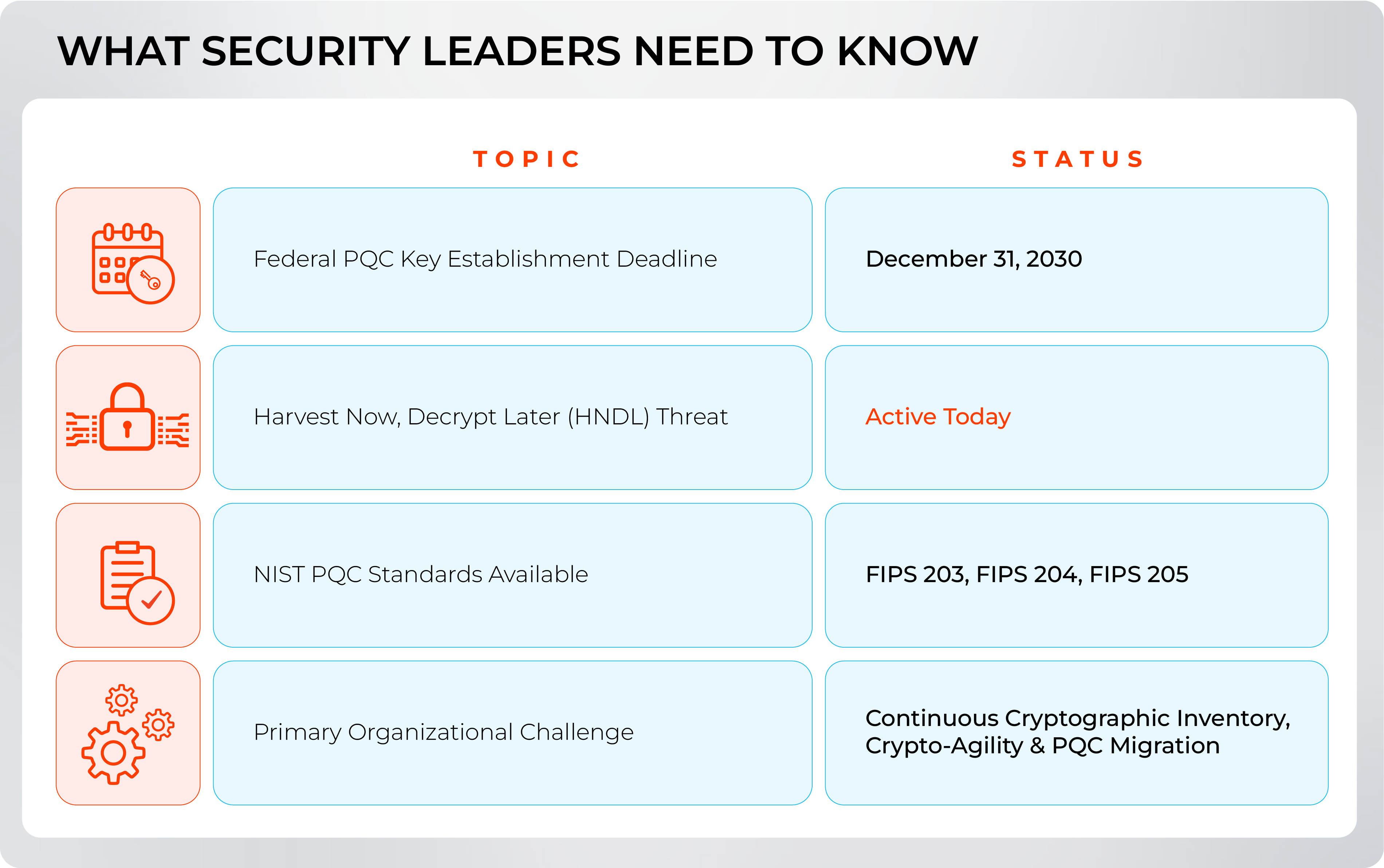
- Transition High Value Assets (HVAs) and high-impact systems to post-quantum cryptography for key establishment by December 31, 2030
- Transition those same systems to post-quantum digital signatures by December 31, 2031
- Accelerate agency migration planning and accountability
- Expand coordination with critical infrastructure sectors to support quantum-resilient modernization
These dates are important because they transform what was previously guidance and planning into measurable execution milestones.
The conversation is no longer about whether organizations should prepare for post-quantum cryptography.
The conversation is now about how quickly they can execute.
Harvest Now, Decrypt Later Is Driving Urgency
The executive order explicitly recognizes the growing risk posed by “Harvest Now, Decrypt Later” (HNDL) attacks. Adversaries do not need a cryptographically relevant quantum computer today to create risk. They only need the ability to collect and store encrypted data now.
Once sufficiently powerful quantum computers become available, encrypted information protected by today’s vulnerable public-key cryptography could potentially be decrypted years after it was originally intercepted. This changes how organizations must evaluate risk.
The critical question is no longer:
“When will a quantum computer arrive?”
Instead, organizations must ask:
“Does the information we are protecting today need to remain confidential into the 2030s and beyond?”
For government information, financial data, intellectual property, healthcare records, defense programs, software supply chains, and critical infrastructure systems, the answer is often yes. That means the risk already exists.
The Hard Part Is No Longer the Standards
These Executive Orders do not introduce new cryptographic standards—they reinforce the urgency of implementing the standards that already exist. With NIST-approved post-quantum cryptographic algorithms now available, organizations can move beyond planning and begin executing structured migration programs.
The challenge is no longer deciding which algorithms to adopt. It is implementing them across complex enterprise environments.
That begins with understanding where cryptography is used across applications, networks, devices, certificates, keys, and third-party technologies. Organizations must then assess which systems rely on vulnerable algorithms, prioritize migration efforts based on business risk, and establish governance capable of managing cryptographic change over time.
For many enterprises, post-quantum migration is far more than a cryptographic upgrade. It is a multi-year business transformation requiring cryptographic visibility, crypto-agility, interoperability, testing, vendor coordination, and long-term operational management.
The Government Paved the Way and Every Enterprise Must Follow
Although the executive orders apply directly to federal agencies, their impact extends well beyond government. Federal contractors should expect increasing pressure to demonstrate alignment with NIST-approved post-quantum cryptography standards as procurement requirements evolve.
Critical infrastructure sectors—including financial services, energy, telecommunications, healthcare, transportation, and defense—should anticipate growing expectations around quantum readiness and migration planning.
Organizations with long technology refresh cycles face an even greater challenge. Many operational technology (OT) environments, industrial control systems, and critical infrastructure platforms rely on technologies that have often been in service for decades.
Every single organization will need to review their infrastructure and develop a PQC migration plan imminently. Waiting until 2030 to begin planning will certainly be too late. In fact, the PQC migration should be complete by then.
Three Priorities for Every Organization
Regardless of industry, three capabilities will determine the success of post-quantum migration programs.
1. Continuous Cryptographic Inventory
Organizations cannot protect what they cannot see.
Identifying where cryptography is used across applications, networks, devices, certificates, keys, protocols, and third-party products is the foundation of every migration strategy.
2. PQC migration via Crypto-Agility
Given the significant number of new PQC standards expected to be announced over the next decade, the organizations best positioned for the post-quantum transition are those that can adapt cryptographic algorithms without disrupting business operations.
Crypto-agility reduces migration risk today while preparing organizations for future cryptographic transitions.
3. Governance and Accountability
Successful migrations require executive sponsorship, clear ownership, measurable milestones, and enterprise-wide coordination.
Cryptographic risk must be treated as a business risk, not simply a technical issue.
The Transition Has Entered a New Phase
These executive orders represent more than a policy update. They represent a shift from preparation to execution.
The federal government has reinforced its commitment to accelerating quantum innovation while simultaneously accelerating the deployment of post-quantum cryptography.
For organizations that have already begun their quantum resilience journey, the orders provide validation that prompt action was the right strategy. For those still evaluating when to begin, the message is increasingly difficult to ignore.
The standards are available. The timelines are becoming clearer. The challenge now is execution.
Organizations that establish cryptographic visibility, embrace crypto-agility, and begin structured migration planning today will be better positioned to protect sensitive data and meet emerging quantum resilience requirements in the years ahead.
At QuintessenceLabs, we continue to work with government agencies, critical infrastructure operators, and commercial enterprises worldwide to plan for and help accelerate their transition to a quantum-resilient security posture.
Official White House Sources
- Executive Order: Securing the Nation Against Advanced Cryptographic Attacks
- Executive Order: Ushering in the Next Frontier of Quantum Innovation
- Fact Sheet: Securing the Nation Against Advanced Cryptographic Attacks
- Fact Sheet: Ushering in the Next Frontier of Quantum Innovation
Share this

World Quantum Day: The Most Important Security Problem No One Celebrates

More than Quantum: Quantum-Secured Messaging Edition